

Why Quality Clearance Can Become a Bottleneck Between Production and Despatch
Introduction
Production completion does not always mean that an aluminium extrusion order is ready for despatch.
After production, the material may still need to pass through inspection and testing before it can be released. Depending on the product and customer requirements, this can involve dimensional checks, visual inspection, chemical or spectro testing, physical testing, rejection assessment, deviation handling, and certification.
This creates an important operational point between production completion and product release.
If inspection is pending, test results are not available, rejected material has not been separated, or a deviation has not been resolved, the finished material may remain blocked even though production itself has been completed.
When quality information is not readily available or the status of each lot or order is unclear, quality clearance can become a bottleneck between the shop floor and despatch.
Production Complete Does Not Always Mean Order Ready
An extrusion order can reach the end of production while still requiring quality clearance.
The operational flow may look like:
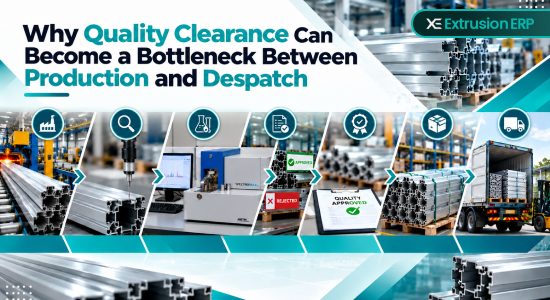
Production → Inspection → Testing → Quality Decision → Release → Packing → Despatch
Each stage has a different purpose.
Production confirms that the manufacturing activity has been completed.
Inspection determines whether the product meets the required characteristics.
Testing provides the required test results.
Quality review determines whether the material can be released, rejected, or handled through an approved deviation.
Only after the required quality status is established can the material proceed confidently toward despatch.
The gap between these stages can become a source of delay when quality status is difficult to track.
Why Inspection Can Hold Up Product Release
Inspection is not simply a final administrative check.
It determines whether the manufactured material meets the required specifications.
For aluminium extrusion, inspection may involve characteristics such as:
- Dimensions
- Surface condition
- Profile requirements
- Physical properties
- Chemical composition
- Customer-specific requirements
- Other applicable quality parameters
If inspection is still pending, the material may not be ready for release.
The problem arises when production knows the quantity has been completed but the status of inspection is not immediately visible.
This can create uncertainty around a basic operational question:
Can this material actually move to the next stage?
Testing Creates Another Point of Dependency
Some products require testing before they can be released.
Testing may involve different records and results depending on the material and customer requirement.
For example, spectro or physical test results may need to be reviewed before the material receives its final quality status.
This creates a dependency between:
Production Completion → Test Result → Quality Decision → Release
If the test information is maintained separately or the result is not readily associated with the relevant production or material record, determining the release status can take additional time.
The production quantity may already be available, but the order can still remain operationally pending.
Rejection Creates a Different Problem
Not every inspection result leads directly to release.
If material does not meet the required specification, it may need to be identified as rejected.
At that point, simply knowing the total production quantity is no longer enough.
The plant needs to understand:
- What quantity was produced?
- What quantity passed inspection?
- What quantity was rejected?
- What was the reason for rejection?
- What quantity remains eligible for release?
This distinction matters because production output and releasable output are not necessarily the same thing.
If rejected quantities are not clearly separated from acceptable quantities, production and despatch teams can have different views of what is actually available.
Deviations Can Delay the Release Decision
There are situations where material does not fully match the expected requirement but may require a deviation decision rather than an immediate rejection.
This creates another quality status that needs to be controlled.
The material may be:
Pending Review → Under Deviation Assessment → Approved / Rejected / Further Action
Until the appropriate decision is made, the material may not be ready for normal release.
The operational problem is not simply that a deviation exists.
It is that production and despatch need to know what the current status is and whether the material can move forward.
Without clear status visibility, teams may repeatedly check with quality personnel before taking the next action.
Quality Status Must Be Visible Before Despatch
Despatch planning depends on knowing what finished material is actually available for release.
A production report may show that an order is complete.
But despatch needs another piece of information:
Has the material been cleared for despatch?
If quality clearance is pending, the order may not be ready even though the production quantity has been completed.
This creates a gap between:
Production Completion
and
Despatch Readiness
When these statuses are not clearly connected, finished material can remain waiting while teams determine whether inspection, testing, rejection, or deviation activities are complete.
The Problem With Treating Quality as a Separate Activity
Quality is sometimes viewed as a separate function that operates after production.
Operationally, it is connected to the movement of the product through the plant.
Production needs quality status to understand what output is acceptable.
Packing needs to know what quantity can be processed.
Despatch needs to know what quantity can be released.
Management needs to understand where completed production is being held and why.
Therefore, quality information becomes operationally important beyond the quality department itself.
A quality decision can directly affect the next stage of the order.
Why Manual Quality Tracking Can Create Delays
When inspection, testing, rejection, and deviation information is maintained through separate registers, spreadsheets, or manual communication, determining the current status can require additional coordination.
Teams may need to check:
- Whether inspection has been completed
- Whether test results are available
- Whether any quantity has been rejected
- Whether a deviation is pending
- Whether the material has been released
- Whether certification is complete
The problem becomes more noticeable when multiple production orders are moving through quality at the same time.
A production team may see several completed orders.
The quality team may have several pending inspections.
Despatch may be waiting for release confirmation.
Without a common view of status, each department may see only part of the process.
Quality Clearance Is a Status-Control Problem
The important question is not simply:
"Was the product inspected?"
The more useful questions are:
- What was inspected?
- What were the results?
- What quantity passed?
- What quantity was rejected?
- Is there a deviation?
- Has the deviation been resolved?
- Has the material been released?
- Is the material ready for despatch?
These questions require quality information to remain connected to the relevant production and material records.
A clear status reduces the uncertainty between production completion and final release.
Pre-Despatch Inspection Adds Another Control Point
Before material leaves the plant, there may be a final inspection or certification requirement.
At this stage, the manufacturer needs to ensure that the quantity being prepared for despatch corresponds to material that has completed the required quality process.
This is particularly important when customer-specific inspection or documentation requirements apply.
The objective is not simply to complete an inspection.
It is to ensure that the right material, in the right quantity, with the required quality status and documentation, is released for despatch.
What a Connected Quality Process Should Provide
A structured quality process should allow the manufacturer to follow the material from inspection through release.
Important information includes:
Inspection Status
Has the required inspection been completed?
Test Results
Are the required spectro or physical test results available?
Rejection
What quantity has been rejected and why?
Deviation
Is any material under deviation review?
Release Status
Has the acceptable quantity been cleared?
Certification
Are the required certificates or quality documents available?
Pre-Despatch Inspection
Has the material completed the required final quality checks?
The purpose is to make the status of the material clear before it reaches despatch.
How Better Quality Visibility Supports Production Flow
Quality control should not be viewed only as a checkpoint that stops production.
When quality information is structured and visible, it can help the plant understand what is:
Completed → Under Inspection → Under Testing → Rejected → Under Deviation → Released
This gives production, quality, packing, and despatch teams a clearer understanding of where an order currently stands.
It also helps management identify whether completed production is being held because of inspection, testing, rejection, deviation, or another release requirement.
That makes the quality process part of production flow rather than a disconnected final step.
How XE - Extrusion ERP Supports Quality Visibility
XE - Extrusion ERP provides structured quality-related information across inspection, testing, rejection, deviation, material status, certification, and pre-despatch activities.
The purpose is to connect quality status with the operational flow of the order.
This helps teams understand whether material is still under inspection, awaiting test results, held due to rejection or deviation, or cleared for the next stage.
By keeping quality information connected to the relevant production and material records, the gap between production completion and despatch readiness becomes easier to monitor.
Conclusion
Quality clearance can become a bottleneck when production is complete but the status of inspection, testing, rejection, deviation, or release is not clearly visible.
The issue is not that quality checks take time. Quality checks are necessary to ensure that the material meets the required specifications.
The operational problem occurs when teams cannot quickly determine what has been checked, what has passed, what is being held, and what is actually ready for release.
For an aluminium extrusion manufacturer, effective quality control therefore needs to do more than record test results.
It needs to provide clear visibility from inspection to release, so that quality decisions support the movement of material through packing and despatch.
The goal is not to remove quality checks. It is to make quality status clear enough that the right material can move forward at the right time.